
Number of Retail Investment Accounts in Kazakhstan Increases 35-Fold Over Five Years
The Analytical Centre of the Astana International Financial Centre, AIFC Insights, has released a review of retail investing in Kazakhstan, highlighting significant structural changes in the country’s capital markets.
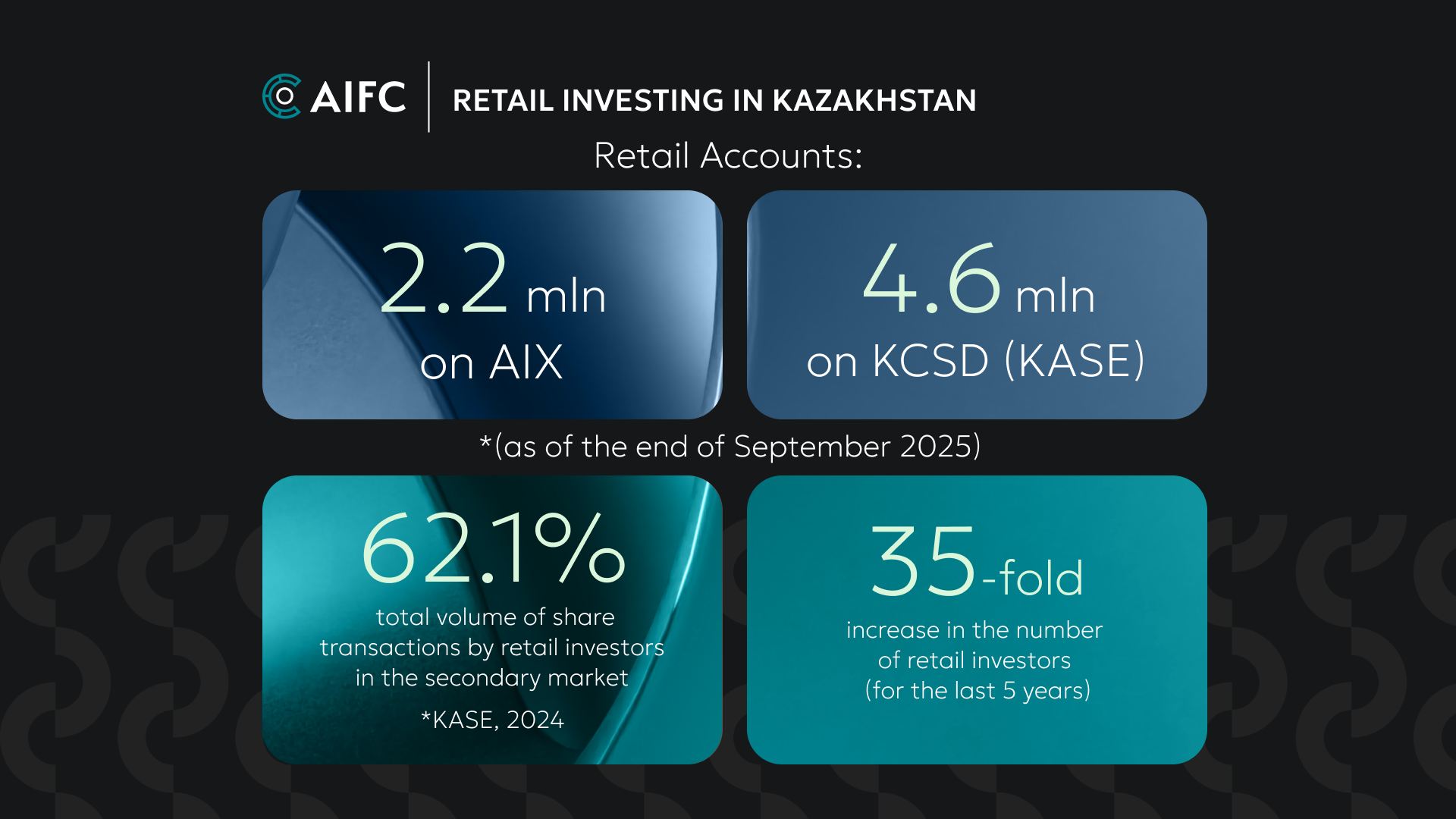
According to the study, the number of retail investor accounts has increased 35-fold over the past five years. The Central Securities Depository of the Astana International Exchange (AIX) holds 2.2 million accounts owned by individuals, while the Central Securities Depository of Kazakhstan Stock Exchange (KASE) registered 4.6 million such accounts (as of the end of September 2025).
In 2024, retail investors on the KASE became the dominant trading force, accounting for 62.1% of total secondary market equity trading volume. This confirms the growing influence of the retail segment.
The report, prepared by the AIFC with support from Freedom Broker, concludes that Kazakhstan’s capital market is undergoing fundamental transformation: households are increasingly investing in the stock market, and investment products are playing a growing role alongside traditional deposit instruments in the savings portfolios of retail investors.
Much of this growth has been driven by IPOs of national companies, which have offered the public a new investment alternative. Large-scale digitalisation of financial services has also played a key role, making investing more accessible and convenient. The spread of mobile investment apps and the ability to open accounts remotely created conditions for an influx of new participants: over 90% of active brokerage accounts were opened within the last five years.
Trading statistics reflect this growing engagement. In 2024, 3.6 million transactions were executed on KASE. In just the first nine months of 2025, the figure had already reached 4.5 million. The role of retail investors in trading activity and price formation of shares of Kazakhstan’s largest companies is increasing.
The report also identifies a notable demographic trend. Young people (18-34 years old) have become the most active group in opening new accounts, supported by user-friendly mobile apps, low entry barriers, and the ability to purchase fractional shares. However, investors aged 35 and above continue to hold the majority of assets, accounting for more than 80% of total securities owned by retail investors.
In terms of invested capital, men account for two-thirds of the total portfolio, while women account for one-third.
At the same time, interest in the debt market is rising.
In pursuit of revenues above bank deposit rates, retail investors have increased their investments in corporate bonds. The share of individuals in this segment has grown more than sixfold, from 3.8% in 2021 to 23.1% in 2025.
The highest concentration of retail capital is observed in bonds issued by microfinance organisations (MFOs), reflecting their comparatively high coupon rates in this category.
“Retail investors’ access to capital markets is a strategic factor for the resilience of the financial system. In recent years, Kazakhstan has made significant progress in this direction. Major IPOs, the development of online brokerage services and digital infrastructure have expanded citizens’ participation in investment activity. Our shared objective is not only to provide access, but to ensure an institutionally reliable environment with transparent rules and strict regulatory standards” said Zhanbolat Kakishev, Chief Product Officer of the AIFC Administration.
Against the backdrop of growing retail participation, improving the population’s financial literacy remains a priority. According to the Agency for Development and Regulation of the Financial Market of Kazakhstan (Agency) only 40.5% of citizens possess basic financial knowledge. To protect the capital of new participants, the Agency has restricted access to complex and high-risk instruments for unqualified investors since January 2025.
The AIFC ecosystem places strong emphasis on financial education. AIX regularly publishes the “I Am an Investor” mini-podcast series, where experts discuss key aspects of this field.
The AIFC Academy continues its ongoing work to improve financial knowledge among both professionals and the broader public. The Academy regularly organises training programmes and develops minor programmes in finance-related disciplines for Kazakhstani universities. These programmes have already been introduced at Almaty Management University, SDU University and Kunayev University.
Earlier this year, the AIFC also launched the FinPro mobile app, designed specifically for senior school students taking their first steps in personal finance. The app combines educational materials, practical exercises and gamification tools to make financial literacy training accessible and engaging. The service features an investment module integrated with the AIX, where users can buy and sell demo shares with virtual money in a training mode.
Through a combination of infrastructure development, digital solutions and education initiatives, the AIFC is laying the foundation for the sustainable, long-term development of Kazakhstan’s financial market.
The full version of the report is available via the official AIFC website.
Reference:
The Astana International Financial Centre (AIFC) is an independent jurisdiction where investors and business meet emerging opportunities of Kazakhstan and Central Asia in a transparent and sustainable environment backed by the principles of English Common Law. www.aifc.kz
AIFC Press Office,
Ainur Issabayeva, press secretary
E-mail: [email protected]