
Strengthening Financial Cooperation: CICA Finance Summit Holds Inaugural Meeting in Astana
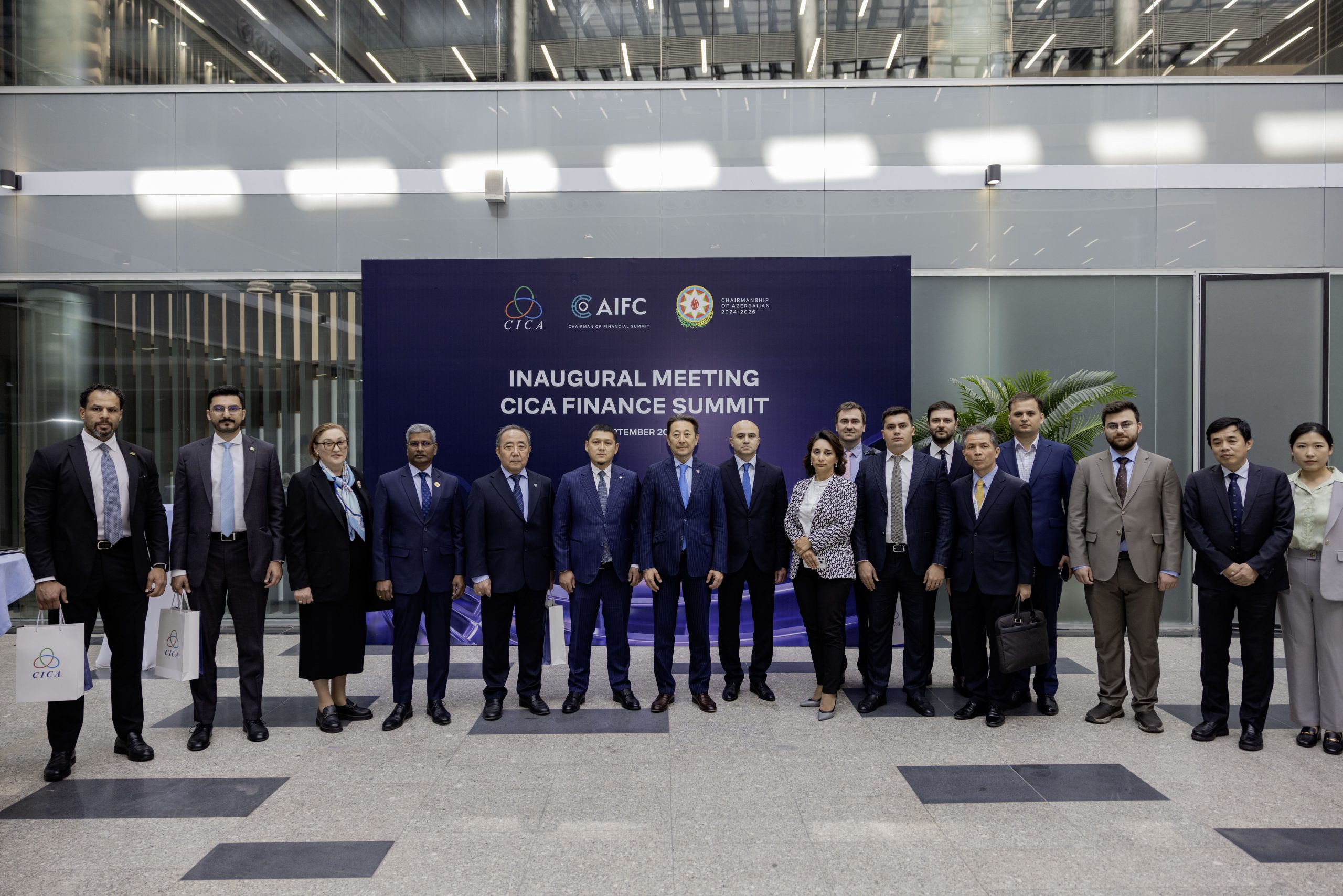
The inaugural meeting of the Finance Summit of the Conference on Interaction and Confidence Building Measures in Asia (CICA) held in Astana under the chairmanship of the Astana International Financial Centre (AIFC).
Welcoming participants to the inaugural meeting, Chairman of the Management Board of the AIFC Authority Bakhtiyar Tleubekov underlined that the AIFC approaches the Finance Summit as a results-oriented mechanism aimed at linking institutions, expertise and capital to drive cooperation across the CICA region. Highlighting the existing solid foundation with over 5200 registered companies from CICA Member States, he noted that the AIFC is ready to lead the platform focusing on cooperation among regulators, exchanges, banks and development institutions.
Reflecting on the early steps to strengthen practical cooperation of the CICA Member States in the financial sector, CICA Secretary General Ambassador Kairat Sarybay highlighted China’s initial efforts to institutionalize this cooperation, that provided a foundation for its further development as initiative to establish the CICA Finance Summit put forward by the President of the Republic of Kazakhstan, Kassym-Jomart Tokayev, at the Sixth CICA Summit in 2022. In a true spirit of continuity, this vision was Implemented under the CICA Chairmanship of the Republic of Azerbaijan guided by its central slogan – “Stronger CICA: connectivity, digitalization and sustainable growth in Asia”.
Secretary General Sarybay emphasized that CICA is actively expanding practical cooperation among its Member States and advancing a cross-dimensional approach based on synergy. He highlighted the existing practical platforms – Business Council and Business Forum – foster investment, trade partnerships and SME development. Noting that economic cooperation is also becoming more inclusive and future-oriented, he pointed to the Women Council and Youth Council, which promote women’s economic empowerment and youth entrepreneurship.
Highlighting the connection between sustainable development and finance, he noted that a resilient financial architecture is essential for implementing long-term economic goals. To build such an architecture and support the ongoing regional efforts, the launch of the Finance Summit reflects this institutional growth – successfully complementing interconnected efforts of CICA advisory bodies and creating additional space for regional dialogue and coordination.
Representing the CICA Chairmanship of Azerbaijan, Javid Nasirli noted that Azerbaijan considers the operational launch of the Finance Summit during its Chairmanship as an important contribution to strengthening the economic dimension of CICA, serving as a timely milestone ahead of the Seventh CICA Summit on 15 October 2026 in Baku. He concluded by expressing the readiness of the Azerbaijani Chairmanship to work closely with all CICA Member States in shaping the Finance Summit into an effective, inclusive and action-driven platform.
Representatives of 16 CICA Member States engaged in comprehensive discussions aimed at addressing shared financial and economic challenges. The dialogue centered on priority areas for future collaboration, including financial connectivity, development financing, sustainable and inclusive finance and digital financial technologies.
China expressed readiness to leverage equity investment to support livelihood projects, such as new energy and water supply, while proposing to foster cooperation in technological empowerment through artificial intelligence, big data, and the Internet of Things (IoT).
To support CICA countries, China expressed readiness to leverage the China-Eurasian Economic Cooperation Fund – an equity investment platform established by China during the SCO Summit in Dushanbe in 2014. Highlighting that 23 CICA Member States are simultaneously SCO Members, Observer States or dialogue partners, China emphasized the strong potential for regional synergy. Through the Fund, China aims to engage in essential livelihood projects in the areas of new energy, water supply and healthcare, while fostering cooperation in technological empowerment through artificial intelligence, big data and the Internet of Things (IoT).
India shared its experience in building open, population-scale digital public infrastructure through the Unified Payments Interface (UPI), processing about 825 million transactions dailyб supported by a comprehensive cybersecurity and Digital Personal Data Protection (DPDP) framework. India offered the capabilities of the State Bank of India (SBI) to collaborate on digital payments, cybersecurity, cross-border trade finance, and specialized training programs for international bankers across CICA member states.
Echoing this emphasis on secure innovation, Israel also underscored that opportunities in digital payments and artificial intelligence must be accompanied by sound regulation, cyber resilience, and investor protection. Pointing to its own economic performance, including a historic surge in foreign direct investment, Israel highlighted the critical role of combining strong financial systems with dynamic capital markets and private-sector financing to overcome fragmented markets and mobilize capital at scale.
Continuing the discussion, Jordan highlighted the importance of mobilizing development and investment financing to overcome regional challenges, expressing support for developing regional co-financing mechanisms for infrastructure, green finance and Islamic finance instruments.
Noting that sustainable growth is closely linked to achieving lasting peace, Palestine called on CICA Member States to enhance economic cooperation, support development projects, and encourage financial institutions to expand their programs in Palestine to mobilize necessary resources and strengthen the local economy.
Russia proposed working towards an increased use of national currencies and digital financial instruments in international settlements, while highlighting the importance of discussing the interoperability of digital currencies, stablecoins, and blockchains to create a stable payment infrastructure.
Türkiye placed a strong emphasis on collaborations in fintech, impact investments, and green finance, extending an open invitation to CICA Member States to participate in the upcoming COP31 action agenda, which Türkiye will host in Antalya in November 2026.
Building upon the discussions during the meeting, participants adopted the Outcome Document, establishing key priorities focused on modernizing national financial institutions, advancing green and sustainable finance, expanding the use of national currencies in mutual settlements, leveraging digital finance and modern infrastructure for cross-border connectivity, supporting capacity-building, and aligning cooperation with the CICA Catalogue of Confidence Building Measures.
The inaugural meeting of CICA Finance Summit was followed by CICA Conference titled “Strengthening Financial Cooperation for Sustainable Growth in the CICA Region” organized to facilitate high-level dialogue among government authorities, financial institutions and business representatives on key trends in the global financial sector.
Opening the conference, CICA Secretary General Kairat Sarybay emphasized that the conference served as a vital bridge to transform the momentum of the newly launched CICA Finance Summit into practical, on-the-ground economic cooperation.
Through dedicated panel sessions, participants exchanged best practices regarding the role of digital finance as an enabler of cross-border interaction, the promotion of green finance, and the strengthening of institutional frameworks to facilitate investment and long-term financial stability across the region. In particular, during the session titled “Promoting Sustainable and Inclusive Financial Development,” Manas Gizhduaniyev, CEO of the AIFC Green Finance Centre and moderator of the discussion, underscored that CICA economies feature diverse financial systems and development priorities, yet face many shared challenges. The discussions centered on delivering practical solutions – such as mobilizing private and cross-border capital, improving the pipeline of bankable sustainable projects, and enhancing the comparability of national frameworks without imposing a single model.
Reference:
The Astana International Financial Centre (AIFC) is an independent jurisdiction where investors and business meet emerging opportunities of Kazakhstan and Central Asia in a transparent and sustainable environment backed by the principles of English Common Law. www.aifc.kz
AIFC Press Office
Ainur Issabayeva, press secretary
E-mail: [email protected]