
AIFC–OECD Research Highlights Nature-Related Financial Exposures in Kazakhstan’s Banking Sector
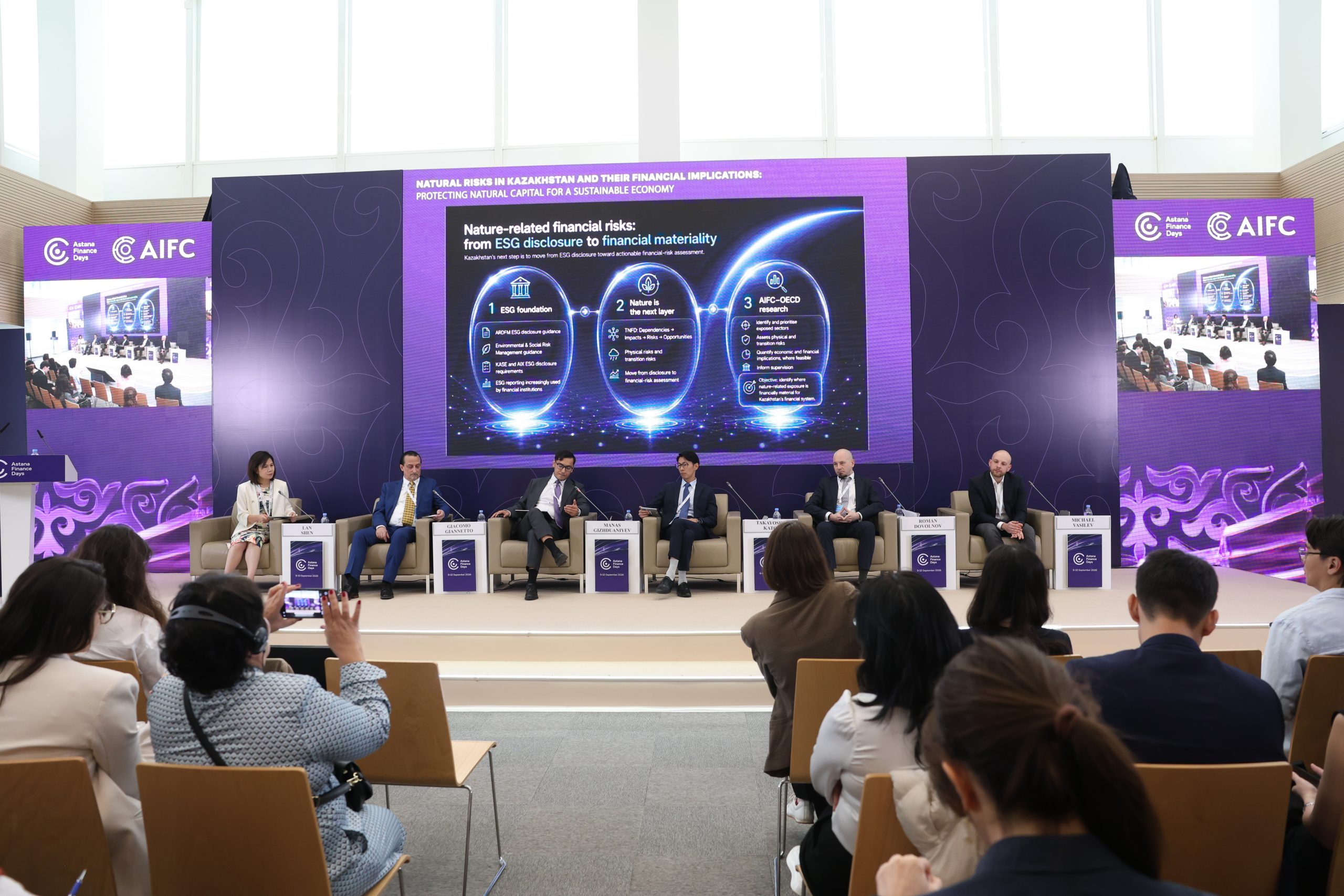
The AIFC Green Finance Centre (GFC), as the Regional Chapter of the Green Investment Principles for the Belt and Road, convened a panel session at Astana Finance Days 2026 on how nature degradation and natural hazards can affect Kazakhstan’s economy and financial system. The discussion brought together representatives of the AIFC, the OECD, multilateral development institutions and business to consider risk identification, disclosure, supervision, insurance and investment in resilience.
During the session, AIFC GFC presented preliminary findings from ongoing joint AIFC–OECD research on nature-related financial risks in Kazakhstan. The analysis begins with the banking sector, which represents around 91% of the country’s financial-sector assets, and applies the ENCORE framework to granular business-lending data to identify where financial exposure coincides with material dependencies on ecosystem services and pressures on nature.
The preliminary screening indicates that approximately 84% of Kazakhstan’s business loan portfolio—around KZT 16 trillion—is associated with activities having at least medium dependence on one or more ecosystem services. Water-related services dominate, including flood mitigation, water-flow regulation, water supply and purification. The research also finds that around 42% of business lending is associated with activities exerting high or very high pressures on nature. Six sectors warrant closer assessment: metal ore mining; metallurgy and metal products; crop and livestock production; food and beverage manufacturing; construction; and crude oil and natural gas production. These figures indicate exposure and potential transmission channels, not realised losses.
“Nature risk is already a financial issue for Kazakhstan, particularly through water. The priority is to translate that understanding into better data, stronger risk management and more resilient investment decisions before physical pressures become financial losses,” said Manas Gizhduaniyev, Chief Executive Officer of the AIFC Green Finance Centre.
The next phase of the research will examine how exposure can translate into economic and financial effects, using flooding as a Kazakhstan-specific case study. Flood risk was selected because it is tangible, geographically mappable and capable of generating direct damage, business interruption, fiscal costs and potential credit and insurance losses.
“Central Asia’s water, energy and land-use challenges are interconnected, so nature-related investment needs to be grounded in local ecosystems and institutions while benefiting from greater regional co-operation. Kazakhstan can mobilise more public and private finance by enhancing the evidence base on nature-related risks and opportunities within its financial system, applying the evidence to build credible project pipelines, including infrastructure, and using risk-sharing instruments where projects are difficult to finance commercially. International experience is valuable, but solutions should be adapted to local circumstances rather than simply copied,” said Takayoshi Kato, Economist in the OECD Environment Directorate and Programme Lead for the Water–Energy–Land-use Nexus in Central Asia.
Participants emphasised that classification and disclosure are only starting points. Effective management of nature-related financial risk will require co-operation among financial supervisors, environmental and sectoral authorities, financial institutions and companies; greater access to location-specific data; common definitions and metrics; and gradual integration of material nature dependencies and impacts into governance, credit assessment and risk-management processes. Participants discussed a layered response combining prevention, resilient infrastructure and ecosystem-based measures with monitoring, early warning, insurance, reinsurance and public financial capacity for losses beyond market absorption.
The ongoing AIFC–OECD research is expected to be completed by the end of 2026. Its next stages will further test sector and geographic exposures, analyse flood-related transmission channels and develop preliminary considerations for strengthening financial resilience. The findings presented at Astana Finance Days remain subject to further validation and do not constitute final regulatory recommendations.
AIFC Green Finance Centre
The AIFC Green Finance Centre supports the development of sustainable finance in Kazakhstan and the wider region through policy and market development, capacity building, advisory services and independent external review.