
Kazakhstan Advances Plans for a National Blue Taxonomy and Blue Finance Market
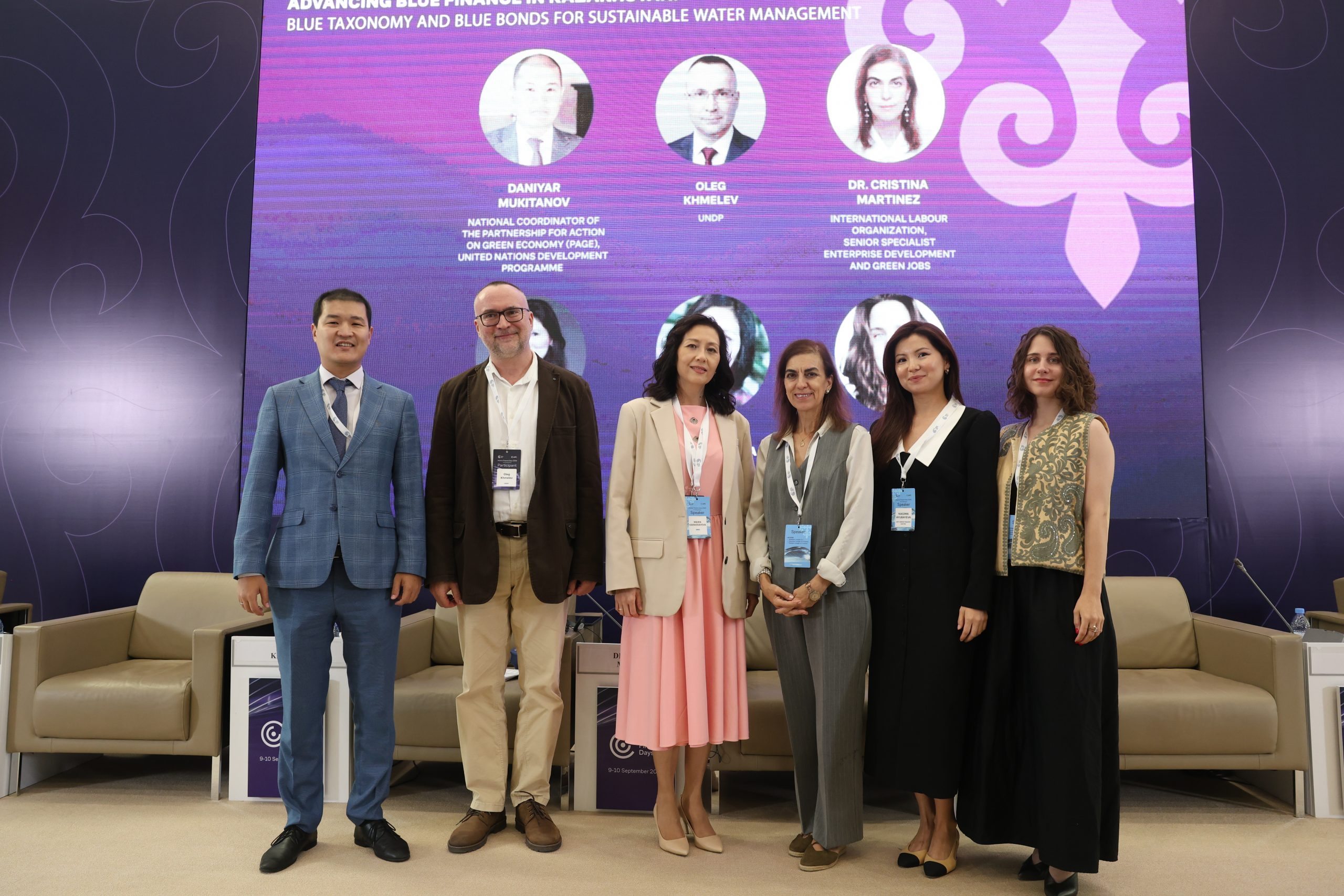
The AIFC Green Finance Centre (AIFC GFC), the United Nations Development Programme (UNDP) and the Partnership for Action on Green Economy (PAGE) convened the session “Advancing Blue Finance in Kazakhstan: Blue Taxonomy and Blue Bonds for Sustainable Water Management” at Astana Finance Days 2026. The discussion outlined practical steps towards a national blue finance architecture, including plans to advance the development of a Kazakhstan Blue Taxonomy and ongoing work on National Blue Bond Issuance Guidelines and accompanying eligibility criteria.
The session brought together Oleg Khmelev, Chief Technical Advisor at UNDP; Nagima Ayubayeva, Deputy CEO of the AIFC Green Finance Centre; Maira Karassayeva, Principal, Regional Policy and Strategy at the European Bank for Reconstruction and Development; Evgeniya Klochkova, Head of the Office for Sustainability at the Eurasian Development Bank and Dr Cristina Martinez at ILO Regional Office Europe and Central Asia/Decent Work Technical Team Eastern Europe and Central Asia. The discussion was moderated by Daniyar Mukitanov, National Coordinator of PAGE.
For Kazakhstan, the blue finance agenda is centred primarily on freshwater security and sustainable water management, while also encompassing the protection of aquatic ecosystems. Water scarcity, ageing municipal and irrigation infrastructure, wastewater treatment, industrial pollution, ecosystem degradation and growing climate risks require a larger and more diverse pool of capital. A clear national framework can give public authorities, issuers, lenders and investors a common language for identifying eligible activities, applying safeguards and measuring environmental impact.
UN PAGE-supported analytical work has helped map Kazakhstan’s blue finance needs, market conditions and potential areas for investment. UNDP has focused on financing needs and potential project areas; UNIDO has examined blue industries, technologies and value chains; ILO has focused on social aspects and green jobs creation under the blue finance umbrella; while UNEP explored blue finance instruments, potential investments and the preparation of the draft National Blue Bond Issuance Guidelines and eligibility criteria; with UNITAR to contribute by developing and launching a capacity building programme on blue finance. Together, this work highlights the predominantly freshwater focus of Kazakhstan’s blue finance agenda and provides a basis for developing a credible pipeline of financeable projects.
“For Kazakhstan, blue finance is an opportunity to translate water security priorities into concrete investment projects. This requires clear criteria, reliable data and impact measurement, coordinated institutions and appropriate financing solutions. Our role is to help bring these elements together and create the conditions for a credible pipeline of financeable projects,” said Oleg Khmelev, Chief Technical Advisor at UNDP.
A national Blue Taxonomy is being considered as a practical tool to provide greater clarity on which economic activities can be classified as “blue” and to help channel finance towards Kazakhstan’s water-related and aquatic ecosystem priorities. Such a framework could introduce measurable technical screening criteria, the Do No Significant Harm principle and minimum social safeguards, while providing practical guidance for market participants and complementing Kazakhstan’s existing Green Taxonomy.
AIFC Green Finance Centre specialists are involved in developing the National Blue Bond Issuance Guidelines with eligibility criteria. Aligned with the ICMA Green Bond Principles and drawing primarily on the IFC Guidelines for Blue Finance, Version 2.0, the framework covers eligible activities, technical screening, and safeguards, while providing a methodological basis for a possible future national Blue Taxonomy.
“Kazakhstan can build on its existing sustainable finance infrastructure, but the immediate task is to apply credible criteria to real assets, improve the underlying data and prepare a first high-quality portfolio,” said Nagima Ayubayeva, Deputy CEO of the AIFC Green Finance Centre.
Participants emphasised that classification alone will not create a market. Project preparation, baseline data, measurable key performance indicators, institutional coordination, affordable external review and, for less commercial projects, guarantees or blended finance will be needed to convert priority areas into bankable assets. Development banks and local financial institutions can play a central role by supporting project preparation, sharing risk, originating portfolios and ultimately refinancing eligible assets through blue-labelled instruments.
The AIFC Green Finance Centre can support this transition by helping market participants screen potential portfolios, develop financing frameworks and impact indicators, build institutional capacity, and access independent external review services, subject to appropriate separation of advisory and assurance functions.
About the Astana International Financial Centre. The Astana International Financial Centre (AIFC) is an independent jurisdiction that offers a favourable legal and regulatory environment and a developed infrastructure for establishing and conducting business, attracting investment, creating jobs and supporting Kazakhstan’s economic development.
About the AIFC Green Finance Centre. The AIFC Green Finance Centre supports the development of sustainable finance in Kazakhstan and Central Asia through policy and market development, capacity building, advisory services and external review of sustainable finance instruments.
About UNDP. The United Nations Development Programme (UNDP) is the leading United Nations organization fighting to end the injustice of poverty, inequality, and climate change. Working with our broad network of experts and partners in 170 countries, we help nations to build integrated, lasting solutions for people and planet.
About PAGE. The United Nations Partnership for Action on Green Economy (PAGE) puts sustainability at the heart of global economic policymaking for a shift in finance and investment towards a just, circular, and green economic transformation. The partnership brings together five United Nations agencies; UNEP, UNDP, ILO, UNIDO, and UNITAR, whose expertise and support assist and lead partner countries towards their transition to an Inclusive Green Economy (IGE) by providing policy advice, assessments, capacity building and analytical tools outputs.