

Introduction
This report explores the regulation and development of Emissions Trading Systems (ETS) and Voluntary Carbon Market (VCM) with a focus on Kazakhstan.
The first chapter is dedicated to the Emissions Trading Systems (ETS). The first section provides a comprehensive overview of global ETS regulations, examining the systems in the European Union (EU), the United Kingdom (UK), the United States of America (USA), Canada, the Republic of Korea, the People`s Republic of China, and Japan. It then delves into the current legislative framework and operational status of the Kazakhstan ETS (KAZ ETS). The current status of KAZ ETS is evaluated with consideration of such aspects as the carbon price and the level of transactions. The current and historical levels of GHG emissions by sectors and the coverage of industries by KAZ ETS are also evaluated. Based on the analysis the main barriers and problems of existing ETS are identified. The international experiences are considered with the goal to identify best practices that could be applied to the KAZ ETS to solve similar problems. The last section offers potential solutions for enhancing the KAZ ETS, including the introduction of paid allocation of carbon allowances, providing an opportunity to trade carbon units on different platforms, expanding the coverage of ETS participants, and the creation of a carbon fund.
The second chapter shifts the focus from the compliance carbon market (i.e. ETS) to the voluntary carbon market (VCM). It reviews international VCM developments in terms of carbon standards and project types. Next, the development of the Renewable Energy Certificates (RECs) market globally is reviewed. The progress of VCM development and current success cases in Central Asia and the Caucasus are considered based on the data from international registries. In the following sections, current barriers hindering VCM development in Kazakhstan are identified, followed by market projections for VCM and I-RECs in Kazakhstan and Central Asia.
Finally, the report presents the progress and work done by AIFC in developing the I-RECs and VCM markets and establishing the AIFC Carbon platform. The platform will facilitate international cooperation and the development of the environmental instruments market in a wider region.
Key Findings
The price of one carbon unit in KAZ ETS is about 1 USD, which is low compared to the other countries
International experience demonstrates that emissions trading systems (ETS) in developed and industrially emerging countries operate on a model of the partial distribution of allowances through auctioning, which helps establish a market price for carbon.
In Kazakhstan, the national Emissions Trading System (Kaz ETS) was launched in 2013 and currently covers 47% of emissions, generated by 135 companies from the energy, mining and manufacturing sectors. However, all allowances are allocated free of charge, resulting in a low average carbon price. The cost of one carbon unit in Kaz ETS is approximately USD 1 – significantly lower than in comparable systems, such as the European ETS, where prices reached USD 90 in 2023.
Figure 1.1.2. Key metrics from carbon markets (in selected countries)
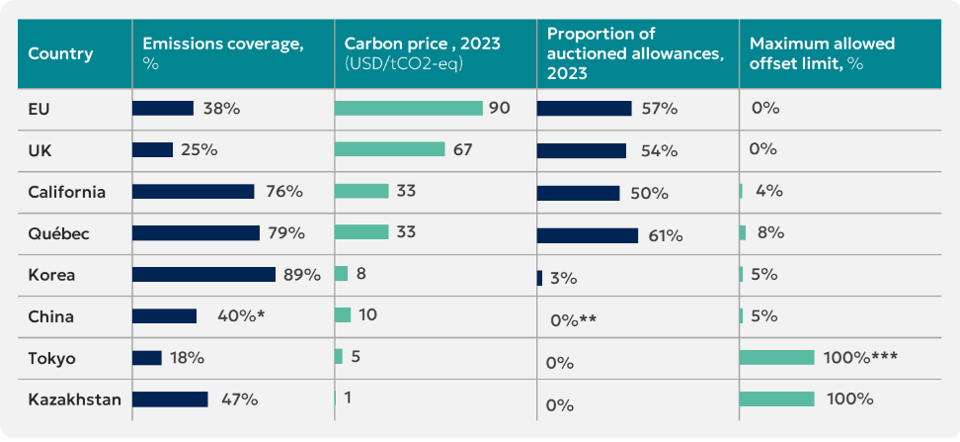
*Of CO2 emissions; **In China auctioning is to be introduced and gradually expanded; ***In Tokyo, quantitative limits apply for “outside Tokyo” credits.
Lessons from international ETS for the Kaz ETS
Considering the current state of the KAZ ETS and international experiences, the application of market approaches and mechanisms is required to revamp and relaunch the existing ETS system in Kazakhstan to create an additional impetus for decarbonisation. Potential solutions for enhancing the KAZ ETS include the introduction of paid allocation of carbon allowances, providing an opportunity to trade carbon units on different platforms, expanding the coverage of ETS participants, and the creation of a carbon fund.
About the Authors


Stay up to date with the latest AIFC news
Receive analytical reports, research, news, event invitations, and other updates from the AIFC
By submitting this form, you agree to our Privacy Policy.