
Astana Hosted Leading Global Experts for IAC Eurasia Arbitration Week 2026
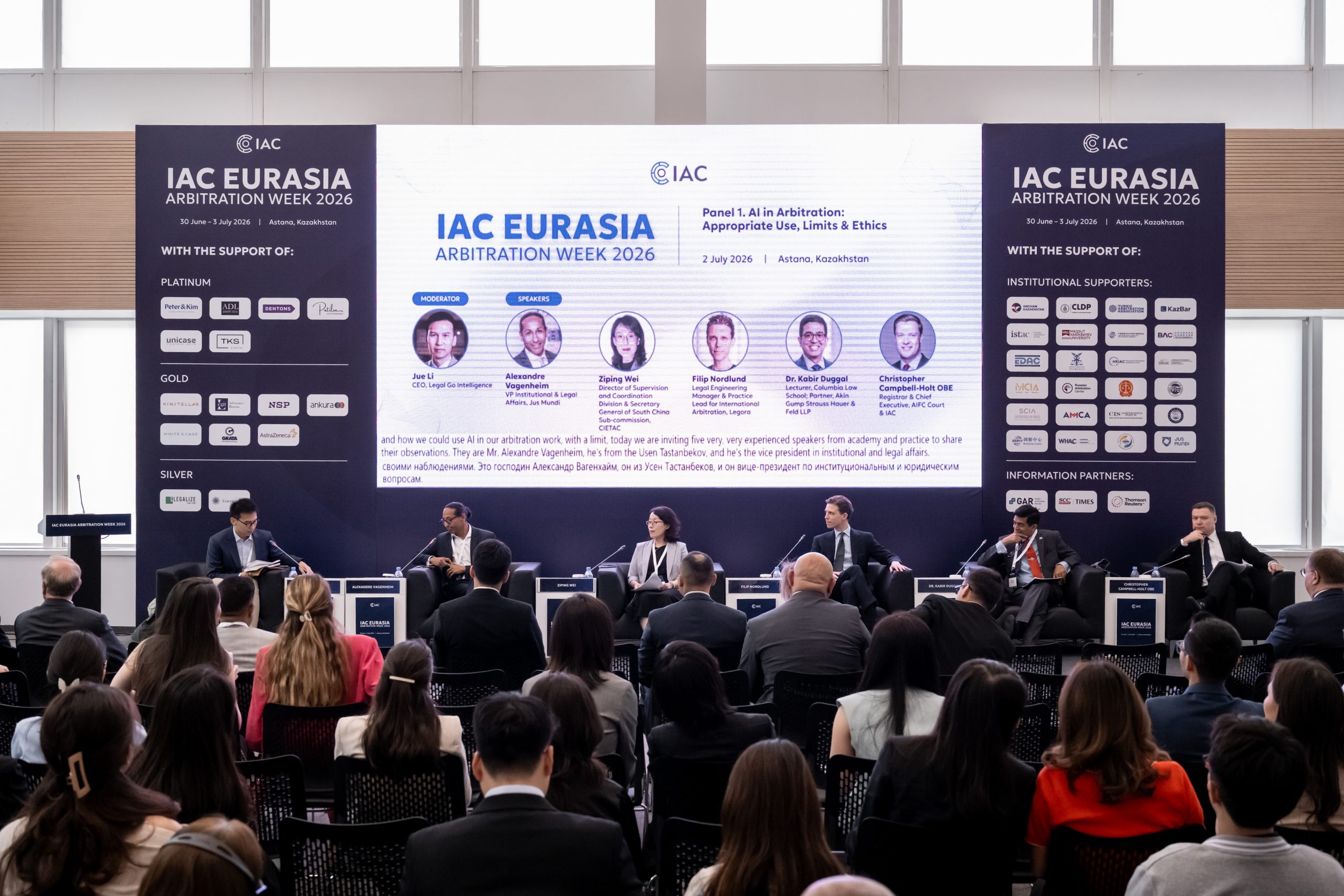
The fourth annual IAC Eurasia Arbitration Week 2026 (IAC EAW26), organised by the AIFC International Arbitration Centre (IAC), successfully concluded in Astana on 3 July 2026 after four days of discussions, professional training, networking and international collaboration, further strengthening Kazakhstan’s position as a regional centre for international dispute resolution.
IAC EAW26 brought together more than 600 participants from 40 jurisdictions, including judges, arbitrators, academics, in-house counsel, private practitioners, government officials, business representatives and dispute resolution professionals. The programme featured 65 distinguished speakers from leading arbitral institutions, universities, courts and law firms across the United Kingdom, United States, Europe, Asia, the Middle East and Eurasia, delivering 21 panel discussions, keynote sessions and practical workshops with the support of 42 supporting organisations.
Building on the success of previous editions, IAC EAW26 reaffirmed its status as one of Eurasia’s leading international arbitration forums, providing a platform for exchanging ideas on the future of arbitration, strengthening professional cooperation and promoting best practices in international dispute resolution.
The four-day programme explored many of the issues currently shaping international arbitration, including the impact of artificial intelligence on arbitral proceedings, investor protection, enforcement of arbitral awards, evolving user expectations, cross-border dispute resolution and the future of arbitration education and practice.
The event commenced on 30 June with the inaugural IAC EAW26 Training Day, organised in collaboration with the Turkic Arbitration Association. The full-capacity programme, “The Arbitrator’s Toolkit: From Appointment to Final Award”, provided practical guidance for arbitrators and practitioners on tribunal appointments, case management, evidentiary issues and drafting enforceable arbitral awards.
The main conference took place on 1-2 July at the IAC premises in Astana. Opening remarks were delivered by Thomas Krümmel, Chairman of the IAC, The Rt. Hon. The Lord Burnett of Maldon KG, Chief Justice of the AIFC Court, together with representatives of the Supreme Court and the Constitutional Court of the Republic of Kazakhstan, highlighting the growing importance of effective dispute resolution mechanisms for international commerce and investment.
Alongside leading practitioners from across the international arbitration community, IAC EAW26 featured internationally recognised experts, including Gary Born, Partner at King & Spalding and one of the world’s foremost authorities on international arbitration; Professor Loukas Mistelis, Professor of Transnational Commercial Law and Arbitration at Queen Mary University of London; Professor Maria Chiara Malaguti, President Emeritus of UNIDROIT and Professor of International Law at Università Cattolica Sacro Cuore (Italy); and Kevin Nash, Director General of the London Court of International Arbitration (LCIA).
Among the conference highlights were discussions on “International Arbitration in Eurasia: Navigating Diverse Traditions, Frameworks & Cultural Expectations”, the keynote session “International Arbitration: Past, Present & Future”, the increasingly significant role of artificial intelligence in arbitration through the panel “AI in Arbitration: Appropriate Use, Limits & Ethics”, and the presentation of the Queen Mary International Arbitration Survey, examining global trends and user expectations shaping the future of arbitration.
Addressing the relationship between arbitration and national courts, Lord Burnett KG emphasised the importance of judicial independence in supporting effective arbitration:
“Arbitration centres only prosper if their supervising courts are independent when applying the governing law, and if awards can be enforced both domestically and internationally in accordance with the governing conventions. The AIFC Court certainly satisfies those tests.”
Professor Loukas Mistelis reflected on the rapid global development of arbitration and the increasing diversity of its users:
“Arbitration has become the victim of its success. It has grown very quickly all over the world, and the result of this is what I would describe, in a positive term, as the democratisation of arbitration. Today, no two arbitrations are alike, especially when we speak about cross-border arbitration involving parties from different regions and lawyers from different legal traditions.”
Gary Born reaffirmed arbitration’s fundamental role in international commerce, observing:
“Arbitration is a fundamental right of citizens and an expression of their contractual freedom. It should not be considered as an infringement upon the monopoly of state justice.”
Throughout the conference, participants noted the strong opportunities for professional networking and international collaboration offered by IAC EAW26. In addition to the conference programme, delegates participated in numerous networking events, facilitating dialogue between arbitration practitioners, businesses, academics and public sector representatives from around the world.
The conference also marked several important institutional developments. During IAC EAW26, the IAC signed Memoranda of Understanding with the Georgian Association of Arbitrators and the National Chamber of Entrepreneurs of the Republic of Kazakhstan “Atameken”, further expanding international cooperation and strengthening partnerships supporting the development of dispute resolution in the region.
Another highlight of the week was the launch of four publications addressing contemporary issues in arbitration and international investment law, providing delegates with new resources to support both academic research and professional practice.
IAC EAW26 concluded on 3 July with the “Young Lawyers’ Day: Arbitration Leaders of Tomorrow”, organised in collaboration with the U.S. Department of Commerce Commercial Law Development Program (CLDP). The programme brought together students, early-career practitioners, academics and internationally recognised experts from leading universities, including Harvard University, Columbia University and the University of California, to discuss developments in international dispute resolution and pathways into global legal practice. The strong participation throughout the day demonstrated the growing interest among the next generation of arbitration professionals.
Reflecting on the significance of this year’s event, Thomas Krümmel, Chairman of the IAC, said:
“Eurasia Arbitration Week 2026 to the IAC means, very importantly, further validation on an international level. If eminent professionals, experts, legal practitioners, members of the worldwide legal community care to come here and share their time, thoughts and expertise with us, this further increases the visibility of the International Arbitration Centre at the AIFC in Astana, Kazakhstan, on the global map of alternative dispute resolution, and confirms its reputation as a serious player and go-to address, not only in Kazakhstan, Eurasia, Central Asia, but also in the rest of the world.”
IAC EAW26 further strengthened Astana’s position as an international meeting point for the global arbitration community and reinforced the IAC’s commitment to promoting excellence, innovation and international cooperation in dispute resolution. Building on the success of its fourth edition, IAC Eurasia Arbitration Week continues to establish itself as the leading international arbitration forum in Kazakhstan and Central Asia, bringing together the world’s foremost practitioners to shape the future of dispute resolution.
Reference:
The International Arbitration Centre (IAC) is a key institution for the Astana International Financial Centre, the Republic of Kazakhstan and the entire Eurasia region. It provides an independent, economical and expeditious alternative to court litigation, operating to the highest international standards to resolve civil and commercial disputes in the AIFC. The IAC has its own panel of outstanding international arbitrators and mediators who are highly experienced, independent and impartial. IAC arbitration awards are recognised and enforceable in Kazakhstan and internationally. The IAC has its own Training Centre and cooperates with leading international education institutions to provide professional legal education that contributes to efficient case management by training lawyers, arbitrators and mediators in the Republic of Kazakhstan and wider Eurasia region. https://iac.aifc.kz/
The Astana International Financial Centre (AIFC) is an independent jurisdiction where investors and businesses meet emerging opportunities of Kazakhstan and Central Asia in a transparent and sustainable environment backed by the principles of English Common Law.https://aifc.kz/