
First in Central Asia: AIFC licenses a platform for trading tokenised real-world assets in the agricultural sector
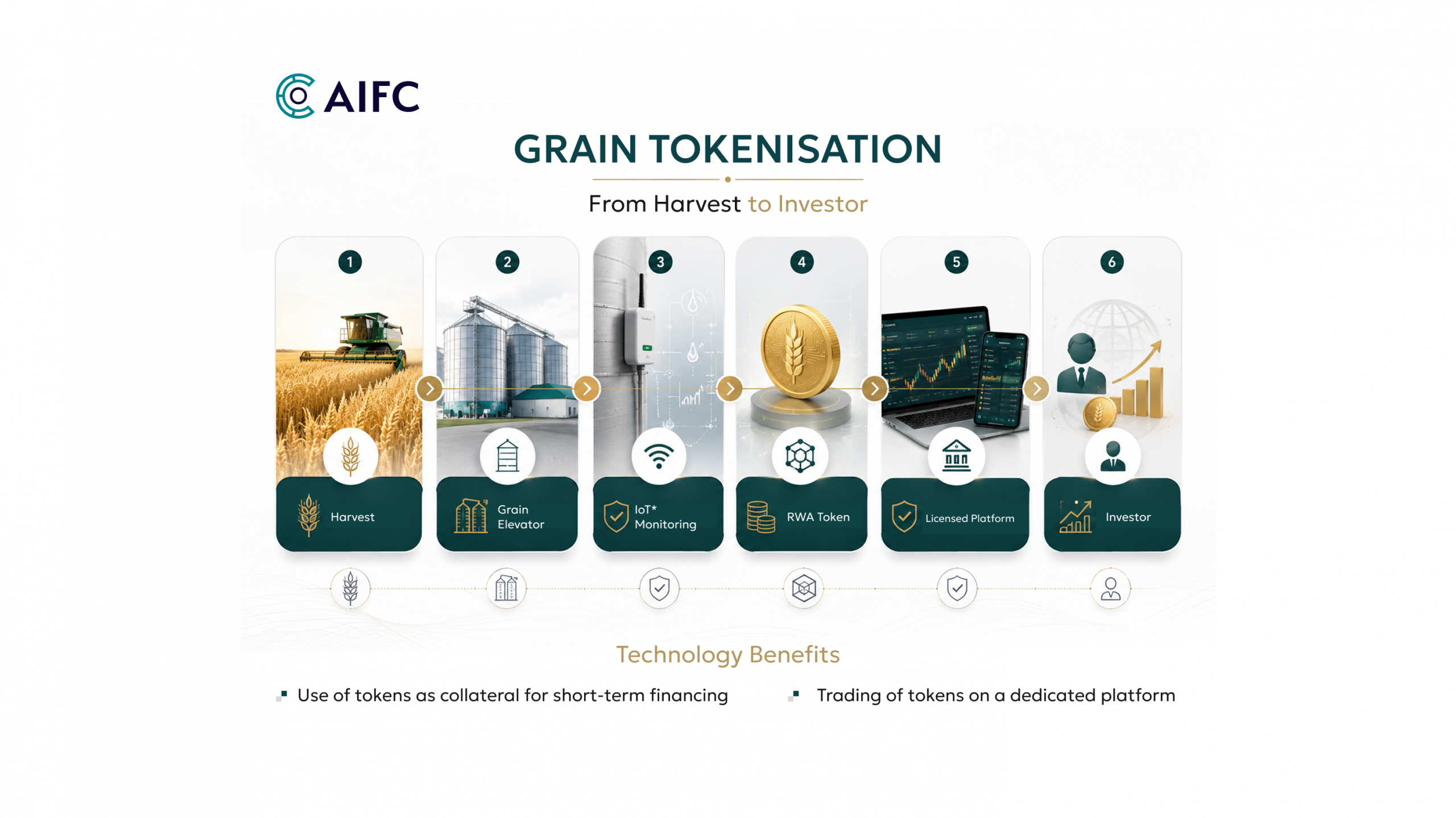
The Astana International Financial Centre (AIFC) announces that the Astana Financial Services Authority (AFSA) has granted Commodity Chain Ltd. a licence to operate a platform for the trading of tokenised real-world assets (RWAs) within the AIFC’s regulated environment. The licence paves the way for the development and future implementation of solutions for tokenising real-world assets, including agricultural commodities, and enabling their trading on an AIFC-licensed platform using advanced digital technologies and the AIFC’s financial infrastructure. The project’s first application will focus on the tokenisation of agricultural products, including grain stored at modernised grain elevators.
Commodity Chain Ltd. will operate within the AIFC’s FinTech Lab regulatory sandbox under a licence issued by AFSA. The project involves the development of infrastructure for the tokenisation of real-world assets, including grain stored at modernised elevators equipped with Internet of Things (IoT) technologies² and artificial intelligence solutions, as well as the trading of these assets through the licensed platform. In the future, the model may be expanded to other regions of Kazakhstan, international markets, and additional categories of real-world assets.
“Tokenisation is more than just a new financial technology. It is a way of linking a digital instrument to a tangible asset within the real economy. In this case, we are talking about grain that is stored, monitored, and represented as a digital financial instrument. This model combines international regulation, blockchain technology, IoT-enabled monitoring, and the practical needs of the agricultural sector,” said Talgat Amanbayev, Chief Innovation Officer of the AIFC Authority.
The platform will be built on a private blockchain infrastructure integrated with IoT technologies. This approach will ensure transparent tokenisation of real-world assets (RWAs), full traceability of their issuance and trading, and a direct link between digital financial instruments and the underlying physical asset — grain stored at licensed elevators. A key feature of the initiative will be the “Transparent Elevator” system. Through digital monitoring using temperature and humidity sensors, automated weighing systems, and other smart technologies, it will enable real-time tracking of both the quantity and condition of stored grain.
This approach is designed to enhance storage transparency and strengthen confidence in tokenised assets backed by physical commodities. The financial model will enable farmers to use tokenised assets as collateral for short-term financing. During periods of higher market prices, grain or tokens may be sold, while smart contracts³ will automatically settle outstanding loans and transfer the remaining proceeds to farmers.
Trading of tokenised assets will take place on a licensed platform, ensuring transparency and reliability of transactions.
“Our goal is to build a digital infrastructure where real-world assets, storage, monitoring, and financial instruments are integrated into a single transparent ecosystem powered by blockchain technology. The project simplifies and accelerates access to financing secured by existing assets and future revenues for a broad range of domestic and international investors within a regulated environment,” said Anvar Nietkaliyev, Senior executive officer of Commodity Chain Ltd.
Reference:
The Astana International Financial Centre (AIFC) is an independent jurisdiction where investors and business meet emerging opportunities of Kazakhstan and Central Asia in a transparent and sustainable environment backed by the principles of English Common Law. www.aifc.kz
¹ Tokenisation of assets is the process of converting ownership rights to tangible assets (such as real estate, gold, etc.) or intangible assets (such as shares, intellectual property, etc.) into digital tokens operating on blockchain technology.
² Internet of Things (IoT) technologies refer to integrated technological solutions for the automated collection, transmission, and analysis of data via the internet, enabling real-time monitoring and management.
³ Smart contract is a blockchain-based digital mechanism that automatically executes predefined contractual terms when specified conditions are met, ensuring transparency, immutability, and efficient fulfilment of obligations.
AIFC Press Office
Ainur Issabayeva, press secretary
E-mail: [email protected]