
Central Asia as a Unified Investment Destination: What the Region Needs to Attract Capital
AIFC Insights, the analytical centre of the Astana International Financial Centre (AIFC), in collaboration with the Institute for Advanced International Studies (IAIS) of Uzbekistan, has prepared a joint study on the investment potential of Central Asia. The study provides a structured overview of priority sectors, investment projects, and sustainable development initiatives across Central Asia, while also examining opportunities for transitioning from national investment strategies towards a more coordinated regional approach.
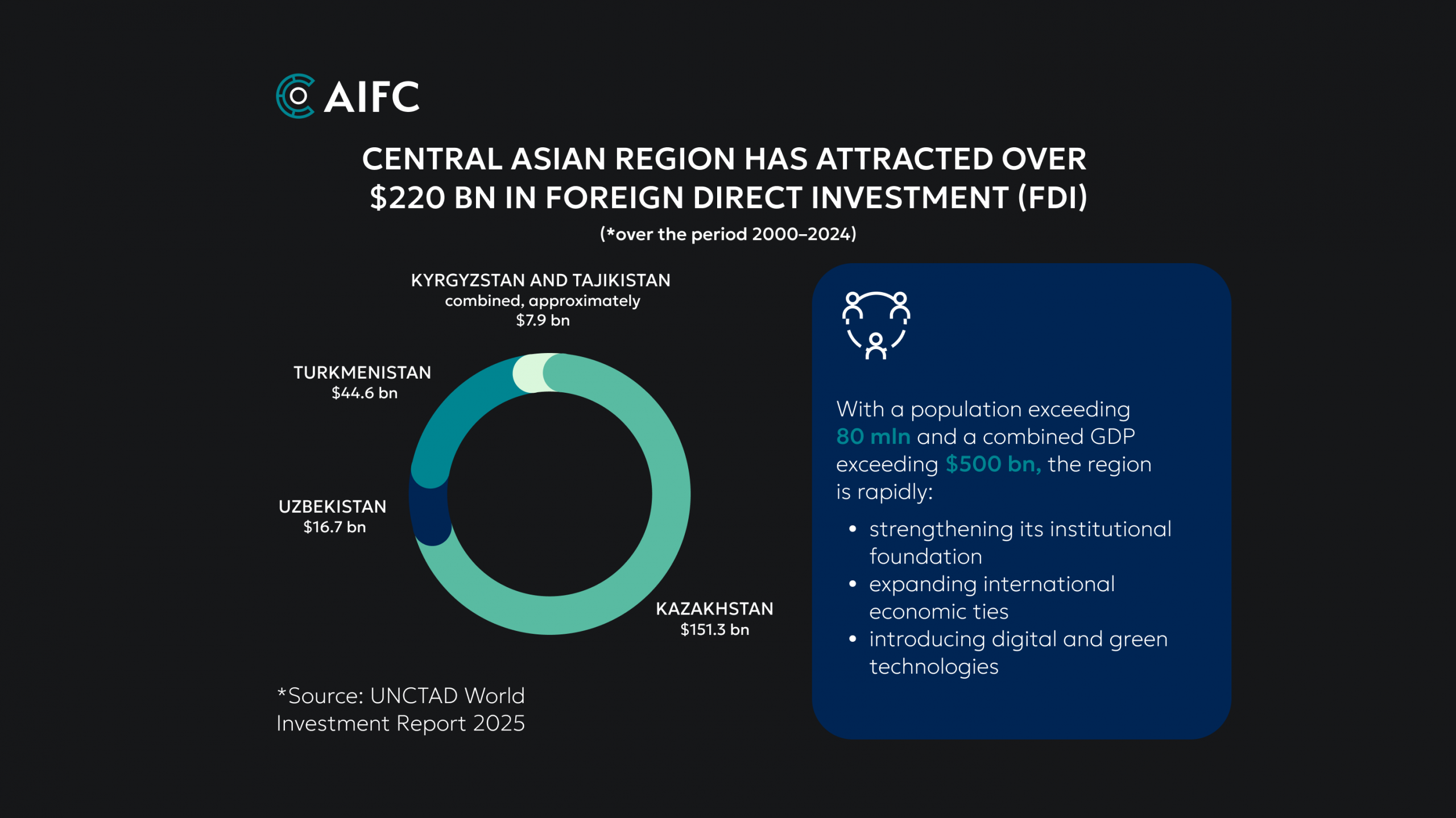
Between 2000 and 2024, the countries of Central Asia significantly increased their accumulated stock of foreign direct investment. According to the UN Trade and Development (UNCTAD) World Investment Report 2025, the region’s total inward FDI stock reached $220.5 billion as of 2024, including $151.3 billion in Kazakhstan, $44.6 billion in Turkmenistan, $16.7 billion in Uzbekistan, and a combined $7.9 billion in Kyrgyzstan and Tajikistan.[1]
Today, the region, with a population exceeding 80 million people and a combined GDP of more than $500 billion, is strengthening its institutional foundations, expanding international economic cooperation, and actively implementing digital and green technologies.
International financial institutions also play a significant role in the region’s investment development. Since its establishment, AIFC has facilitated the attraction of more than $21 billion in investments into various projects by providing infrastructure for cross-border capital flows and international business activities.
Renat Bekturov, Governor of the AIFC, noted:“Today, a regional approach to investment and industrial development is becoming one of the most promising directions for growth. Central Asia possesses complementary economic advantages, while the synchronisation of national and regional strategies allows the region to be viewed as a single economic zone with substantial investment capacity and significant growth potential. The AIFC remains committed to serving as a platform for such cooperation by providing a transparent and predictable environment for cross-border projects.”
One practical example of regional cooperation is the establishment of the Central Asia International Centre for Industrial Cooperation along their shared border by Kazakhstan and Uzbekistan. The centre is expected to include joint ventures, logistics hubs, and trading platforms operating under harmonised standards and procedures, which may in the future serve as a model for expansion into other border areas across the region.
Additional areas of regional cooperation include coordination in water diplomacy, climate adaptation of infrastructure, investments in green energy, development of sustainable agriculture, digital transformation, and workforce development.
These areas are gradually forming the foundation for a more integrated investment partnership across the region.
One of the key challenges remains the absence of a unified investment positioning for Central Asia. Despite the progress achieved by individual countries, international investors still tend to view the region as a collection of separate jurisdictions rather than as a single economic space. This reduces the overall investment impact and limits the region’s competitiveness in attracting global capital.
Akram Umarov, Director of Institute for Advanced International Studies and First Vice-Rector for Academic Affairs at University of World Economy and Diplomacy, stated:“International investors increasingly assess development opportunities through the lens of macro-regions, and Central Asia possesses all the necessary prerequisites to form a unified investment space. Joint promotion of cross-border projects opens access to larger-scale opportunities and strengthens the region’s position on the global investment map.”
The authors of the study highlight that, in the context of global competition for capital, regions that can offer investors not only individual projects, but also scale, predictability, and strong institutional mechanisms, win. In this context, Central Asia has all the prerequisites for developing a more cohesive regional investment brand and strengthening its position internationally.
The study is available at the following link
Reference:
The Astana International Financial Centre (AIFC) is an independent jurisdiction where investors and businesses meet emerging opportunities of Kazakhstan and Central Asia in a transparent and sustainable environment backed by the principles of English Common Law. www.aifc.kz
AIFC Press Office,
Ainur Issabayeva, press secretary
E-mail: [email protected]
[1] Source: World Investment Report 2025: International investment in the digital economy