
AIFC Publishes First Regional Capital Markets Review of Central Asia and the Caucasus
AIFC Insights, the analytical centre of the Astana International Financial Centre (AIFC), has released a report «Capital markets in Kazakhstan, Uzbekistan, Kyrgyzstan and Azerbaijan: prospects and trends». The publication represents the first consolidated analysis of capital markets across four economies of Central Asia and the Caucasus — Kazakhstan, Uzbekistan, Kyrgyzstan and Azerbaijan.
The report provides key capital market segments, institutional frameworks, regulatory developments and investment trends, while identifying common challenges and opportunities shaping the development of each market.
AIFC Governor Renat Bekturov noted: «This report provides an overview for stakeholders, including investors, financial institutions, regulators, industry experts, and market participants – who seek to understand the dynamics shaping capital markets in Central Asia and the Caucasus. Structural reforms, growing macroeconomic resilience, and increasing integration with global financial systems are reshaping how capital is mobilized, allocated, and invested across the region. At the AIFC, we view regional cooperation, transparency, and investor confidence as essential foundations for capital market development».
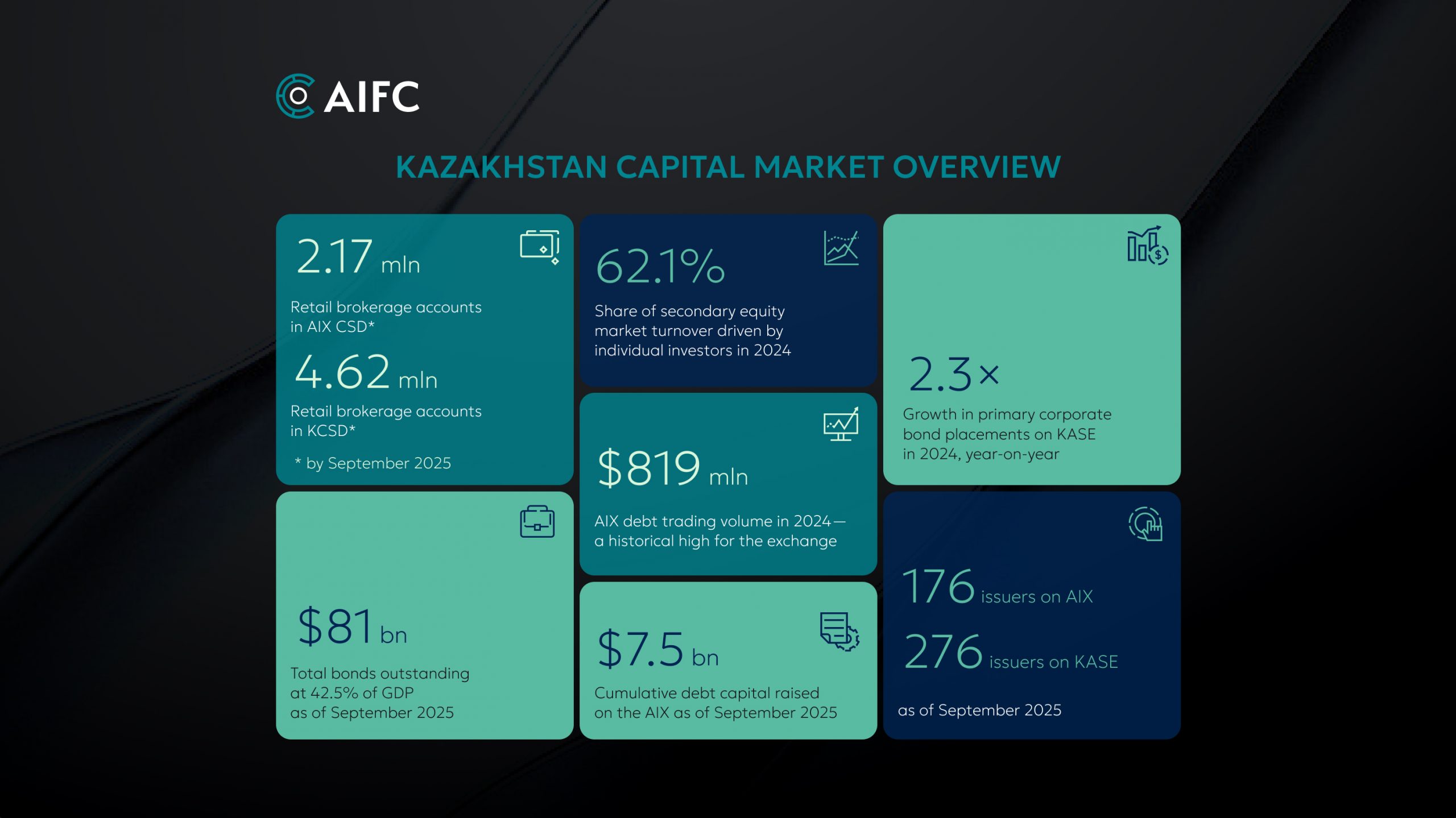
According to the report, Kazakhstan stands out for having one of the most developed capital market architectures among the markets covered in this overview. The country holds sovereign savings exceeding $110 bn and comparatively advanced market infrastructure. Retail investors continue to play an increasingly important role in Kazakhstan’s capital market. As of the end of September 2025, the number of brokerage accounts reached 4.62 million at the Kazakhstan Central Securities Depository (KCSD) and 2.17 million at AIX CSD. In 2024, retail investors accounted for 62.1% of secondary equity market turnover, while during the first nine months of 2025 their share stood at 55.2%. Over the same period, the number of equity transactions increased to 4.5 million, compared to 3.6 million for the whole of 2024.
Debt instruments continue to play a central role in financing economic activity. As of the end of September 2025, the combined value of outstanding corporate and government bonds amounted to approximately $81 bn, equivalent to around 43% of GDP.
Uzbekistan
Each regional market is developing along its own trajectory and reflects distinct strategic priorities. In Uzbekistan, the current stage of capital market development is closely linked to ongoing regulatory reforms. One of the market’s key characteristics is the difference between its nominal size and actual market liquidity. Total equity market capitalization stands at approximately $22 bn; however, free-float market capitalization is estimated at around $350 mln, which indicates that secondary market depth and liquidity are still developing.
In recent years, Uzbekistan has actively accessed international debt capital markets. In 2025, sovereign borrowing amounted to approximately $1.5 bn, primarily to finance the budget deficit and support government-led development projects.
Kyrgyzstan
Kyrgyzstan’s capital markets are developing within an open and increasingly integrated economy, supported by strong cross-border economic ties and the significant role of the financial sector in driving economic growth.
The market continues to demonstrate gradual infrastructure development and growing trading activity. Trading volume on the Kyrgyz Stock Exchange reached $573.9 mln by June 2025, nearly doubling the level recorded for the whole of 2023.
As of September 2025, shares of 23 issuers were listed on the Kyrgyz Stock Exchange, with a combined market capitalisation of approximately $2.6 bn.
Trading activity remains concentrated in the debt market segment. In early 2025, trading volume in corporate bonds reached $150.5 mln, exceeding equity trading volume of $104.9 mln. Government securities accounted for only $13.9 mln of total turnover.
Azerbaijan
The oil and gas sector continues to play a dominant role in Azerbaijan’s economy, remaining a key contributor to GDP, exports and fiscal revenues. A landmark milestone for the market was the completion of Azerbaijan’s first-ever initial public offering (IPO) in 2024.
Debt instruments continue to constitute the core segment of the domestic capital market. During the first three quarters of 2025, trading activity on the Baku Stock Exchange increased, supported by government bond issuances with a total value of approximately $2.3 bn. Market outlooks point to the continued development of Azerbaijan’s capital market, including new corporate listings and the planned issuance of sovereign infrastructure bonds in 2026.
For comparative purposes, the report also examines the experience of Poland, Vietnam and Abu Dhabi (UAE) as markets that have achieved significant scale since the 1990s. For example, Kazakhstan and Poland demonstrate comparable market capitalisation-to-GDP ratios of approximately 22% in 2024. However, Poland is classified as a Developed Market[1], while Kazakhstan is classified as a Frontier Market. Poland’s experience shows that the key factors behind a market status upgrade are not so much the economic size of the market, but rather the quality of regulation, well-developed operational infrastructure, and market accessibility for investors.
In addition, FTSE Russell has confirmed the reclassification of Vietnam from Frontier Market to Secondary Emerging Market status, with the change set to take effect in September 2026. Notably, this upgrade reflects not so much the size of the market as its accessibility and operational investability, including the removal of pre-funding requirements for foreign institutional investors and the introduction of a formalised process for handling failed trades.
This demonstrates that the development of a capital market depends not on its economic scale alone, but on sustained efforts to address operational barriers and strengthen regulation, as well as on the quality of institutions, market reliability and accessibility for investors.
AIFC as a Bridge to Global Markets
The report places particular emphasis on the Astana International Financial Centre (AIFC) and its role in connecting regional markets with the global investment community.
The Centre provides investors with infrastructure based on English common law principles and international regulatory standards. The AIFC’s tax framework has been officially recognized by the Organisation for Economic Co-operation and Development (OECD), positioning the Centre as one of the few frontier-market financial hubs aligned with global tax transparency standards.
A key component of the ecosystem is the Astana International Exchange (AIX), operating on the Nasdaq technology platform. The exchange is integrated with leading international market infrastructures through Euroclear and the Tabadul Digital Exchange Hub, which connects AIX with the Abu Dhabi Securities Exchange (ADX). Solidcore Resources completed its redomiciliation from Jersey to the AIFC jurisdiction in 2023 and designated AIX as its primary listing venue. This case underscores AIX’s alignment with international standards and its capacity to support efficient cross-border settlement.
Overall, capital markets across the region continue to evolve, gradually strengthening their role in mobilizing long-term financing. Further progress will depend on deepening market liquidity, expanding the issuer and investor base, and further convergence with international market practices.
The full report is available via the link.
Reference:
The Astana International Financial Centre (AIFC) is an independent jurisdiction where investors and business meet emerging opportunities of Kazakhstan and Central Asia in a transparent and sustainable environment backed by the principles of English Common Law. www.aifc.kz
AIFC Press Office,
Ainur Issabayeva, press secretary
E-mail: [email protected]
[1] FTSE Russell, a leading global index provider, classifies capital markets into four categories: Frontier Markets, Secondary Emerging Markets, Advanced Emerging Markets, and Developed Markets. Kazakhstan is currently classified as a Frontier Market, reflecting both its current stage of market development and its growth potential.